
(June 3, 2026) – Pittsburgh-based Carnegie Mellon University’s School of Drama utilized several grandMA3 consoles for lighting control and DisplayStations for designer stations on its latest production, Stephen Sondheim’s iconic musical “Company,” staged in the Philip Chosky Theater. ACT Entertainment is the exclusive distributor of MA Lighting products in North America.
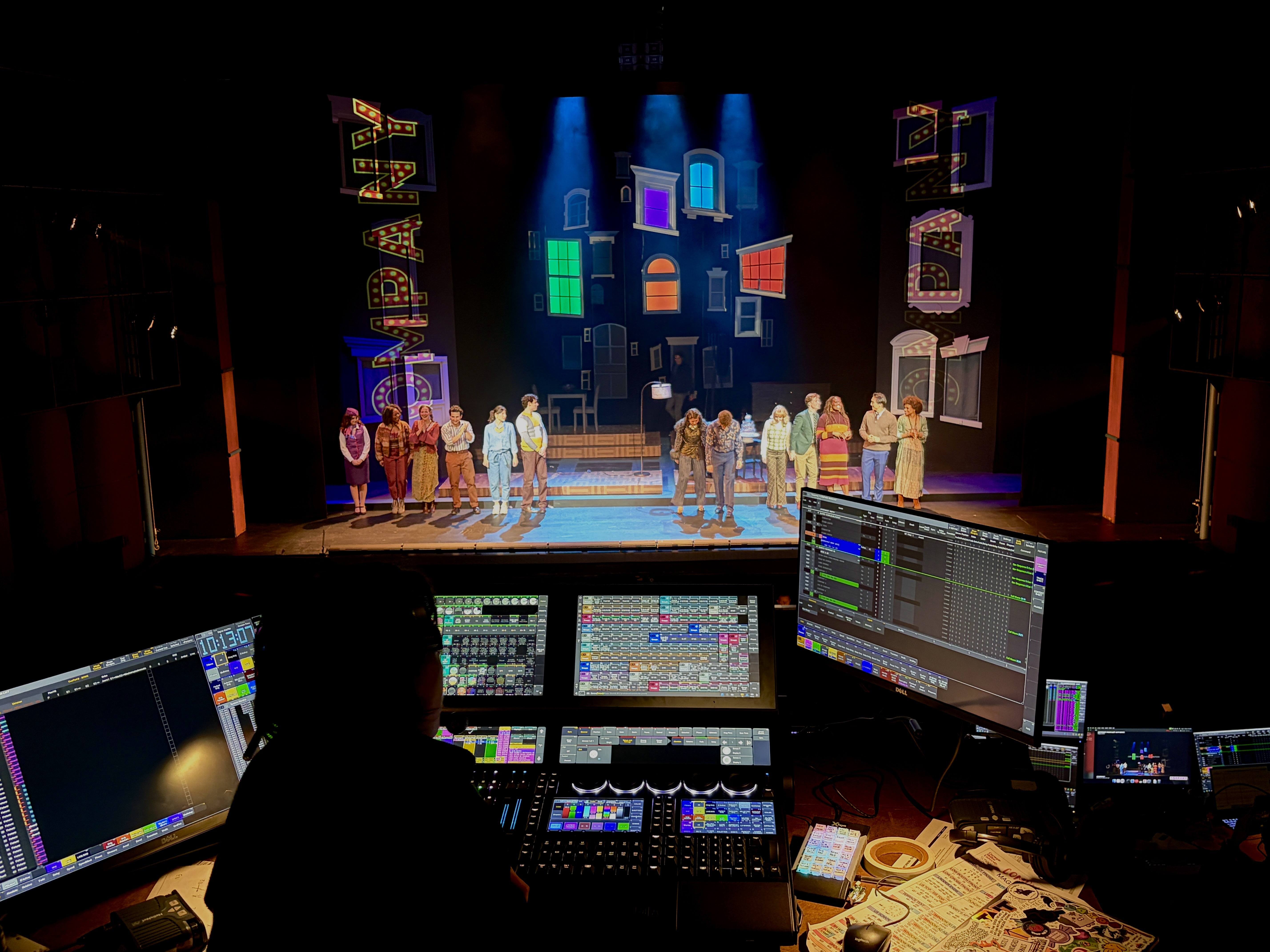
Photo Credit: Sam Regardie
The CMU School of Drama produces a dozen or more shows annually, at least one of them a musical, which play in the school’s theater and studio venues. Students comprise the vast majority of the production teams for School of Drama shows, with the lighting department entirely student staffed. This year’s musical was Sondheim’s groundbreaking 1970 show exploring modern relationships, marriage, and loneliness, “Company,” staged in the Philip Chosky Theater, a traditional proscenium space which accommodates up to 450 patrons.
The CMU School of Drama owns a grandMA3 light and a grandMA3 onPC command wing for programming tasks as part of students’ coursework. ACT Entertainment loaned the school a grandMA3 compact, which replaced the grandMA3 light for coursework so the latter console could move to the Chosky Theater, marking the first time the grandMA3 light was used on a production by the School of Drama.
Also on loan were a pair of ACT Entertainment’s DisplayStations, hardware designed to make deploying grandMA3 front of house stations rapid and repeatable. Pre-configured and booting directly into grandMA3 onPC, DisplayStation enables users to define views on up to four screen outputs for stage technicians, designers, producers, video trucks and any collaborator who needs to be in lock step with the grandMA3 session.
Lighting Manager Samuel Greco, who handled troubleshooting and backup for Lighting Designer Hailey Garza, found DisplayStation to be an efficient and effective tool. “Since it was a single box with grandMA3 loaded on it, I wasn’t spending time managing it to make everything work,” he explains. “We literally pulled DisplayStation out of the box, pressed power and were on the network.”
“It was very gracious of ACT to loan us the new DisplayStations, which put the lighting design team more in the center of things and helped us get into the network faster,” says Garza. “With this setup on the design table, one of my three assistants used her own DisplayStation and monitor to work independently at the end of the table, focused on setting spotlight cues and communicating adjustments to the programmer while accessing the network separately from my DisplayStation.”
When Garza was named the show’s lighting designer last year, she began talking with Lighting Programmer Gemma Tait about what she envisioned “Company” would look like. “In the professional world, the programmer and lighting designer are working more closely than before, almost like the programmer is part of the design team, and I wanted that here,” says Garza. “The show was a final opportunity for those of us graduating to develop our skills on the grandMA3 and try something new. All of us are familiar with other consoles; I had used the grandMA3 before but not in a theater context.”
Tait had used the platform in the concert world but “using it on a linear project was a useful and educational experience for me,” she says. “I appreciated the opportunity to utilize the grandMA3 light for ‘Company,’ and the DisplayStations really streamlined communication between the entire design team.”
Tait recalls being introduced to the concept of the DisplayStation last year at LDI, and Garza notes that the school’s faculty and “very strong alumni network” facilitated acquiring the new devices from ACT. “ACT set up an email mail chain for us to use if we encountered any issues and was very responsive as we began the process of incorporating the DisplayStations into our lighting network and maintaining them throughout the process,” Tait adds.
Garza built her lighting rig from the school’s extensive inventory supplemented by the loan of two fixtures. “There were about 300 fixtures, 35 of them moving lights,” Greco reports. “‘Company’ was comparable in scale to ‘Titanic,’ the musical we did last year.”
The show used four automated deck tracks driven by TAIT Navigator, two of them with wireless power and data. “They were moving platforms that allowed us to drive scenic elements back and forth on stage,” explains Greco. “We also had two three-story towers that the actors could run up and down as staircases with windows and roller shades covered with lights; two of the towers were mapped by projectors.”
He was grateful to learn about the workflow of grandMA3 and DisplayStation for a production as ambitious as “Company.” “It’s such a good experience for us to have the opportunity to utilize systems different from what we’re used to and learn their pros and cons as we go out into industry.”
“With the industry growing and changing so much, it’s exciting to know the school supports us and gives us the resources to make us more marketable to the professional world and able to make a living doing what we love,” Garza concludes.
Read this story on other sites:
https://www.svconline.com/the-wire/grandma3-and-act-entertainments-displaystations-support-cmu-school-of-dramas-production-of-company
https://www.tpimagazine.com/act-entertainments-displaystations-support-cmu-school-of-drama/