
USA/Europe – American singer Hayley Williams’ tour is out with a Hippotizer TEKA MX Series Media Server, enabling a projection-led design that’s transforming theaters into immersive environments.
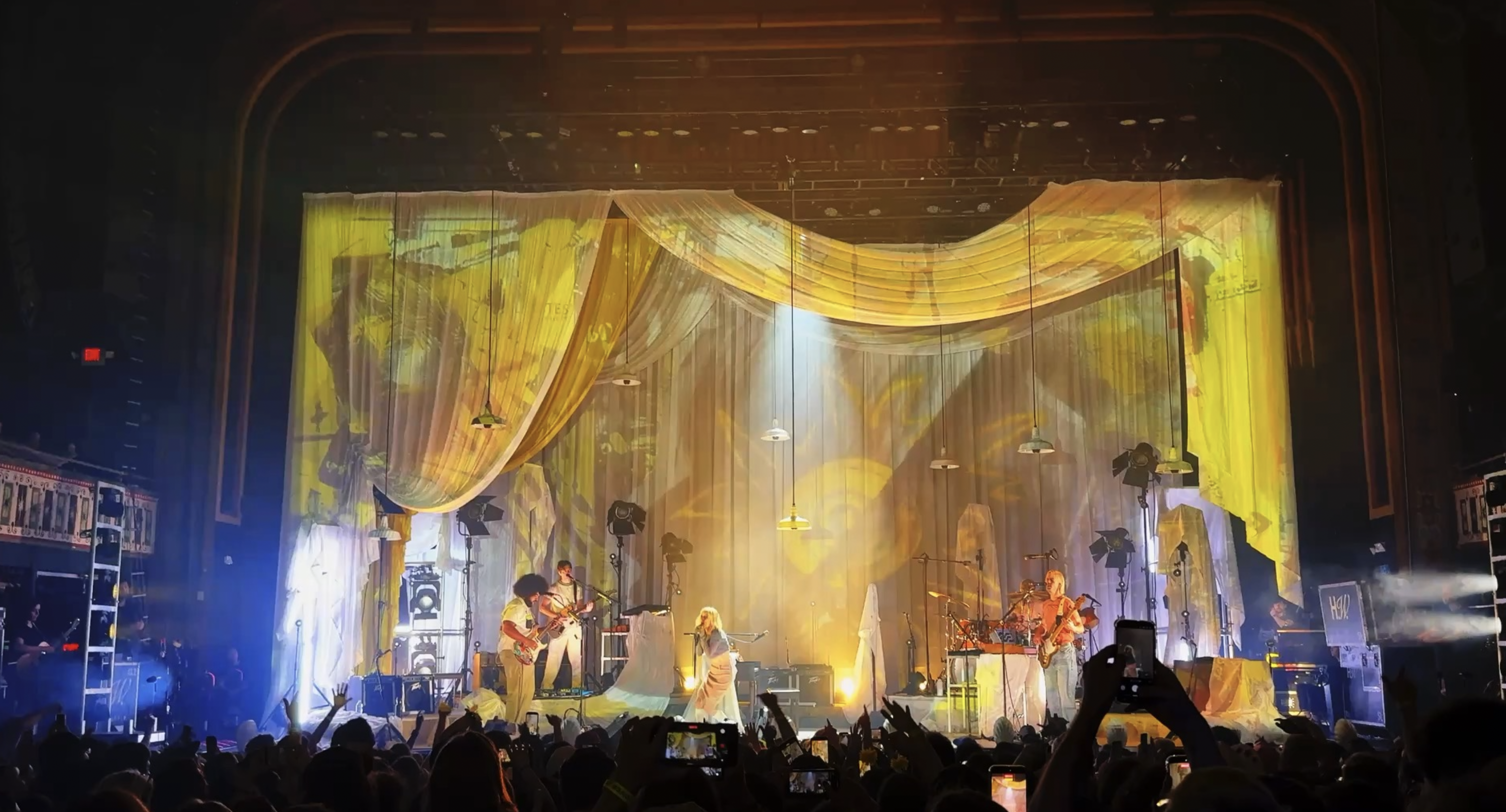
Photo Credit: © Craig Mitchell / LMG Touring
The Hippotizer TEKA MX is part of the new range of MX Series Media Servers from Green Hippo, an ACT Entertainment brand. It was specified for its compact 1RU footprint, performance headroom, and touring efficiency, and has been key to maintaining high-end playback capability within the constraints of limited FOH space.
The production relies heavily on projection as a primary scenic and atmospheric tool. Therefore, it required a media server capable of layered playback, real-time manipulation, and tight integration with grandMA control in a streamlined touring package.
The creative concept was developed collaboratively by Lighting Director and Programmer Matthew Greer, designers Tobias Rylander and Michael Straun, Media Server Technician Dan Gentile, and Production Manager Riley Emminger. LMG Touring supplied the tour.
“Tobias and I wanted to approach Hippotizer in the same way we approach lighting fixtures,” says Straun. “We use the same language and the same design thinking. We were working from a single projection source and didn’t require IMAG or a heavy video infrastructure, so the TEKA MX was the right fit both technically and economically.”
“The projection canvas is literally the entire stage,” explains Cory Froke, Technical Project Manager at LMG. “We’re using white drapes over custom-built lighting ladders and scenic pods, along with fabric hung from truss in more traditional configurations. In effect, the entire proscenium becomes the raster.”
Straun continues: “We started by sharing ideas and references with Hayley. During preproduction, we tested one of her music videos across the stage, scenic elements, and performance space. It immediately confirmed the direction — the imagery sat naturally across the environment and reinforced the concept.
“We wanted to be in a room that was timeless and would make the audience ask, ‘where are we?’ The idea was to create a space that feels timeless and undefined, where it isn’t immediately clear whether Hayley is entering a space or leaving it. That ambiguity became a core part of the design.”
Content was developed by Frameworx, who created abstract environments, textures, and atmospheric sequences designed to complement Williams’ music. These were combined with reworked album artwork, promotional imagery, and re-synced music video elements.
“We had limited time to build and refine content,” says Straun. “Hippotizer gave us the ability to load, test, and manipulate material quickly. Using tools like brightness, contrast, and the internal effects engine, we could adapt content directly to the physical environment and immediately evaluate how it behaved on stage.”
“Being able to house the servers directly in the FOH lighting rack significantly reduced system footprint and simplified load-in,” adds Froke. “In many of the venues on this tour, FOH space is extremely limited, so that efficiency is critical.
“The MX Series allows designers to work with high-resolution content and complex layering without constantly needing to think about system limitations. The system is designed with a modular approach and future workflows in mind. Support for emerging standards like ST 2110 and IPMX shows where the platform is heading, which is important for long-term production planning.”